
Collection: Lozenge Cut Engagement Rings
-
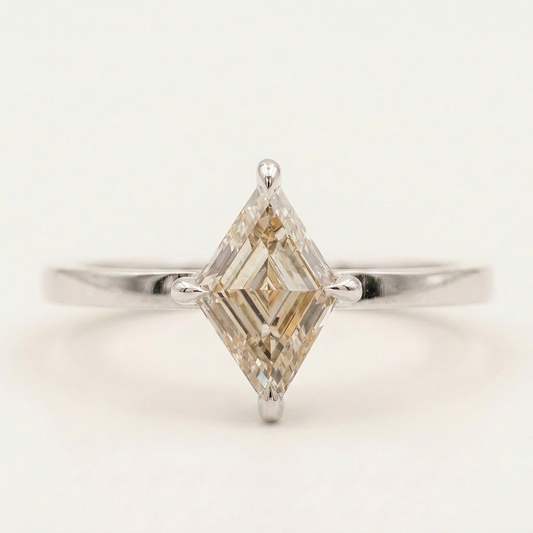
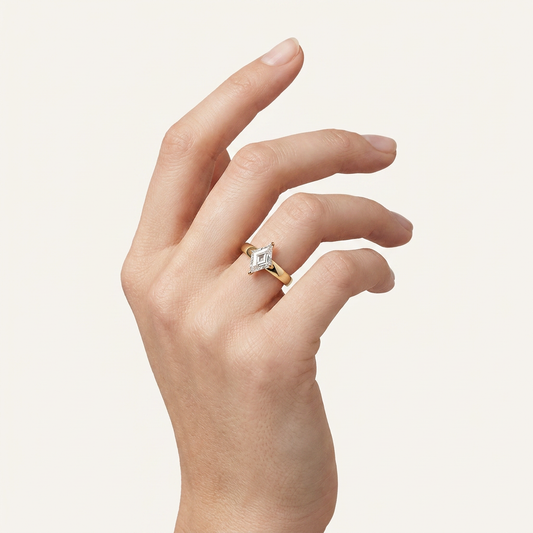
1.40 CT Lozenge Cut Salt and Pepper Diamond Solitaire Ring
Starting fromRegular price $1,979Sale price $1,979 Regular price -
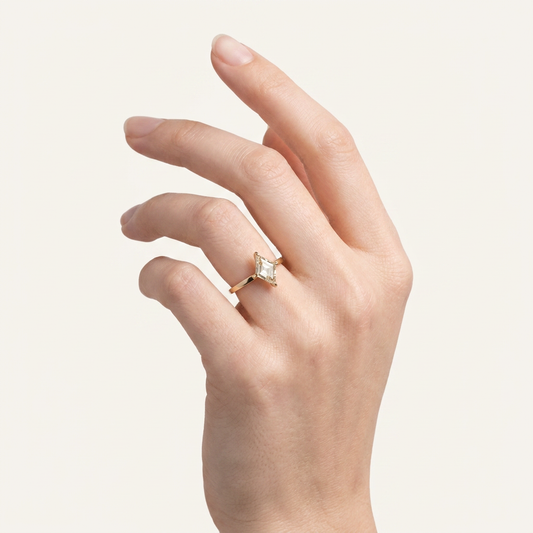
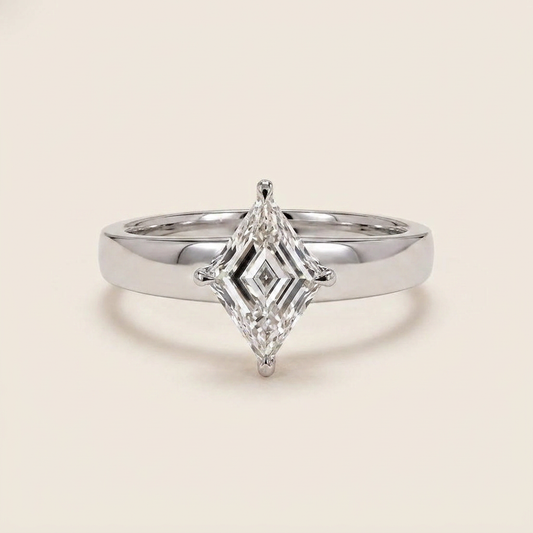
Moissanite 2.05 CT Lozenge Cut Solitaire Ring
Starting fromRegular price $346Sale price $346 Regular price$380.60Sale -
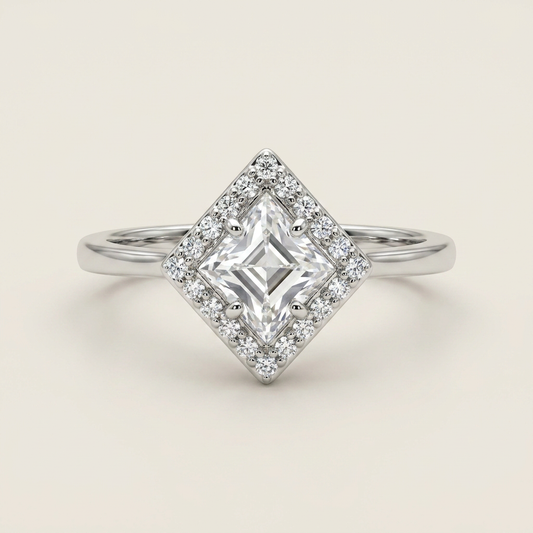
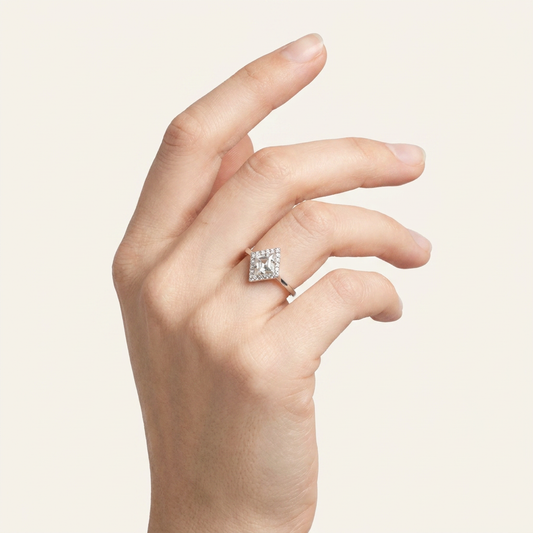
Moissanite 1.65 CT Lozenge Cut Halo Ring
Starting fromRegular price $478.50Sale price $478.50 Regular price$526.35Sale -
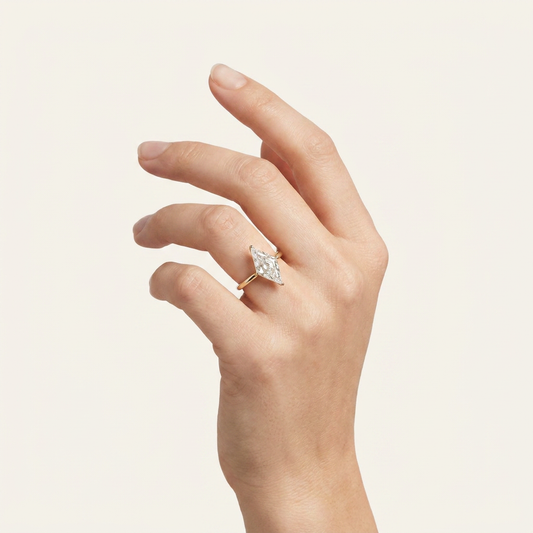
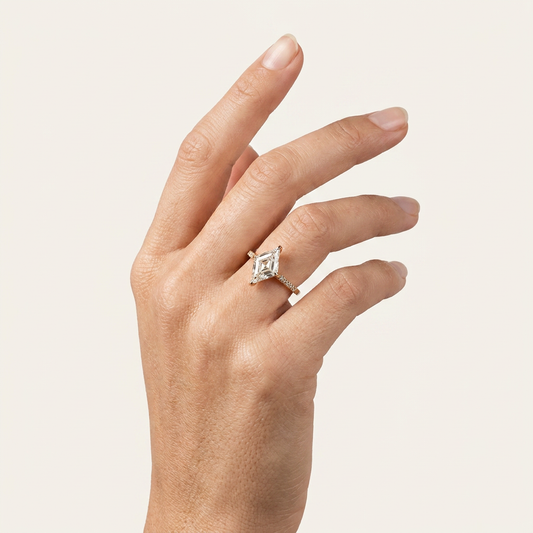
Lab Grown 2.50 CT Lozenge Cut Diamond Solitaire Ring
Starting fromRegular price $1,439Sale price $1,439 Regular price -
Lab Grown 3.00 CT Lozenge Cut Diamond Solitaire Ring
Starting fromRegular price $2,799Sale price $2,799 Regular price


Showing 5 of 5
A lozenge cut engagement ring features a true four-sided rhombus diamond with equal edges, sharp points at the top and bottom, and an Art Deco silhouette that's having a real moment again. Shop handcrafted lozenge cut rings in moissanite, salt and pepper diamond, and lab grown diamond, ready to ship across the USA with a lifetime warranty.
Lozenge Cut Engagement Rings: The Art Deco Shape Making a Comeback
A lozenge cut diamond is a true rhombus: four sides of equal length meeting at four points, with the two widest points running left-to-right through the center of the stone. It's the same silhouette as the diamond suit on a playing card, cut with large, open step-cut facets rather than the tiny brilliant facets you would see on a round stone. That open facet structure is what gives a lozenge cut its signature look; instead of a thousand tiny flashes of light, you get a few large, dramatic flashes as the stone catches the light with a smoother, glassier glow in between.
The shape first became popular in the 1920s and 1930s Art Deco period, when geometric, architectural jewelry was at its peak, and it's resurfacing now for the same reason: couples want a ring shape that photographs differently, wears differently, and does not look like everyone else's Pinterest board.
At IBIZ Jewel, our lozenge cut engagement rings are handcrafted in-house and ship from stock across the USA no long custom production wait. Every ring includes a certified grading report (GIA, IGI, or AGS), free US shipping on orders over $100, and our lifetime service warranty.
Why Couples Are Choosing Lozenge Cut Engagement Rings
-
A true rhombus, not an approximation. Because all four sides are equal, the lozenge cut reads as clean and intentional, unlike shapes with mismatched proportions.
-
A different kind of sparkle. Step-cut facets trade brilliance for depth and bold flashes of light instead of constant shimmer, which reads as more sophisticated and less "loud" on the hand.
-
Vintage meaning, modern execution. The Art Deco association gives the shape built-in history without requiring an actual antique (or the fragility that comes with one).
-
Elongates the finger. Like marquise and kite cuts, the pointed top and bottom create a lengthening illusion, but the equal sides keep it looking more structured and symmetrical.
-
Rare enough to matter. Most jewelers do not stock the lozenge cut at all. Choosing it signals a couple that did their research.
Shop Lozenge Cut Engagement Rings by Setting Style
Solitaire Lozenge Engagement Ring
A single rose stone held by prongs at its four points with nothing else competing for attention. This is the setting that shows off the step-cut facets most clearly, since there's no halo or side stones breaking up the line of the stone.
Bezel Lozenge Engagement Ring
A metal rim wraps fully or partially around the stone's edges, protecting the pointed corners (the most vulnerable part of any lozenge cut) while adding a sleek, modern frame. This is our most recommended setting for anyone with an active lifestyle or hands-on job.
East-West Lozenge Engagement Ring
The stone is set sideways, running left to right across the finger instead of up and down. This orientation is trending across every elongated shape right now, and it changes the entire personality of the ring to be more fashion-forward and less traditional.
Three Stone Lozenge Engagement Ring
A lozenge center stone flanked by two side stones, often round, baguette, or smaller lozenge shapes, for added width and traditional past-present-future symbolism in a distinctly geometric package.
Halo & Pavé Lozenge Engagement Ring
Smaller diamonds surround or line the band around a lozenge center stone, adding brilliance and visual size without a jump in carat cost. This softens the architectural lines of the lozenge just slightly while keeping the shape clearly recognizable.
Choosing Your Stone: Moissanite, Salt and Pepper, or Lab Grown Diamond
Moissanite has more fire than a mined diamond and holds up beautifully in a step cut, giving the lozenge shape's signature large-facet flash even more punch. It's the top choice for buyers who want maximum visual impact without the price tag of a natural stone.
Salt and Pepper Diamond Engagement Rings
A genuine natural diamond with visible black and white inclusions, unique to every stone. In a lozenge cut's open facets, those inclusions are more visible than they'd be in a brilliant cut which is exactly the point. You can actually see the character of the stone, not just its sparkle.
Lab Grown Diamond Lozenge Engagement Rings
Chemically identical to a mined diamond, at a significantly lower cost per carat. For buyers who want the traditional clear, colorless look of a diamond (rather than moissanite's extra fire or salt and pepper's inclusions) in the largest carat size their budget allows.
Choosing the Right Metal
-
White Gold: sharpens the geometry and gives the step-cut facets a cool, clean contrast
-
Yellow Gold: classic Art Deco pairing; warm tone plays beautifully against a lozenge's large open facets
-
Rose Gold: softens the architectural lines and adds warmth, especially with salt and pepper diamond
All three are available in 14K and 18K across our lozenge cut collection.
Pairing a Lozenge Cut Engagement Ring with a Wedding Band
Because a lozenge cut has pointed corners at the top and bottom, a straight wedding band will usually leave a visible gap on either side. A curved or notched contour band cut to trace around the lozenge's points sits flush and is the pairing we recommend most. A plain thin band can also work well with a bezel-set lozenge, since the bezel itself already creates a clean edge for the band to sit against.
Lozenge Cut vs. Other Shapes: How It Compares
-
Lozenge vs. Kite: Both are four-sided and pointed, but a lozenge has four equal sides (a true rhombus), while a kite has two pairs of unequal sides. "Lozenge" reads more symmetrical and Art Deco; "kite" reads more asymmetric and contemporary. See our Kite Cut Engagement Rings if you want the sharper, less symmetrical version of this look.
-
Lozenge vs. Marquise: A marquise has curved sides meeting at two points (an eye shape); a lozenge has straight sides meeting at four points. A marquise is rounder and more brilliant-cut; a lozenge is more angular and step-cut.
-
Lozenge vs. Emerald: Both use step-cut facets for that same glassy, dramatic-flash sparkle, but emerald is rectangular with cut corners, while lozenge comes to sharp points on all four sides.
FAQ
1. What is a lozenge cut diamond?
A lozenge cut diamond is a true rhombus shape, four sides of equal length meeting at four sharp points, cut with large step-cut facets rather than the small brilliant facets of a round diamond.
2. Is a lozenge cut the same as a kite cut?
No. A lozenge cut has four equal sides, forming a symmetrical rhombus. A kite cut has two pairs of unequal sides, making it more asymmetrical. They look similar at a glance but are distinct shapes.
3. Are lozenge cut diamonds durable enough for daily wear?
Yes, with the right setting. The four pointed corners are the most vulnerable part of the stone, so we recommend prong settings positioned directly at each point or a bezel setting that fully protects the edges for active daily wear.
4. Why does a lozenge cut diamond sparkle differently than a round diamond?
Lozenge cut diamonds use step-cut facets, large, flat, rectangular facets running parallel to the stone's edges, which produce bold, occasional flashes of light rather than the constant micro-sparkle of a round brilliant cut. Inclusions and color are also more visible in a step cut, so cut quality and clarity matter more when choosing one.
5. What wedding band pairs with a lozenge cut engagement ring?
A curved or notched contour band designed to trace around the lozenge's pointed corners pairs best, so there is no visible gap. A plain thin band also works well if your lozenge stone is bezel-set.
6. Do you ship lozenge cut engagement rings within the USA?
Yes, we offer free shipping on US orders over $100, and every ring ships with a certified grading report and our lifetime service warranty.