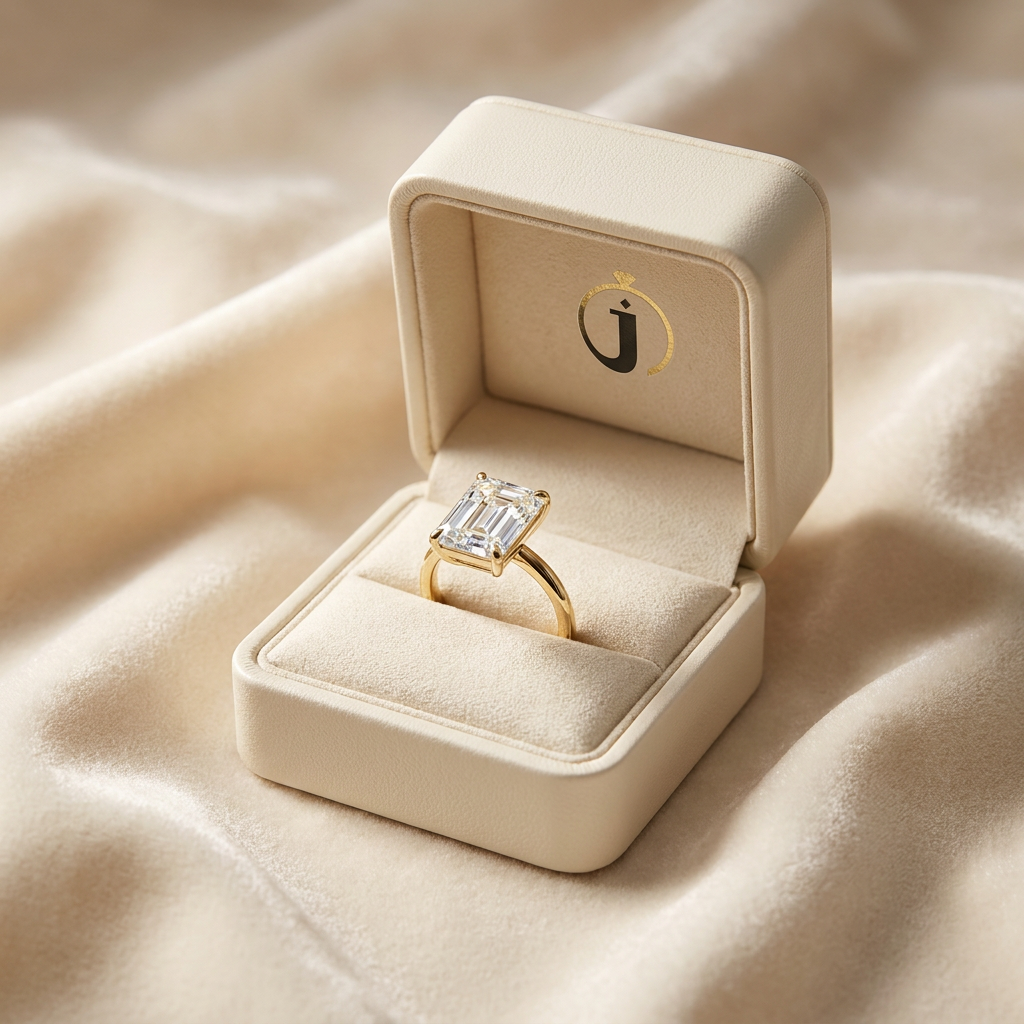
Lab Grown 2.00 CT Emerald Cut Diamond Solitaire Ring
Get It By Sep 30 and Oct 07.
✓ Free First resize within 7 days
Personalize the inside of your band up to 15 characters.
Please enter engraving text.
Maximum length is 15 characters.
Couldn't load pickup availability
Interest-Free Installments - See Your Options
-
Handcrafted in workshop
-
Free shipping and insurance
-
Lifetime service warranty
Overview
A two carat emerald cut lab grown diamond in four prongs on a plain band. Emerald cuts show long, mirror-like facets instead of sparkle, so clarity matters; ours are VVS2 to VS1 and D/E colour. The setting is deliberately simple, with a slim band that makes the stone look longer on the hand. Made in sterling silver or 10k, 14k or 18k gold in white, yellow or rose. Made to order in our workshop. Free engraving. Free first resize within 7 days. Free insured worldwide express shipping. Lifetime service warranty.
Specification
Stone: Lab Grown Diamond
Shape: Emerald
Carat: 2.00 CT
Color: D/E
Clarity: VVS2 - VS1
Setting: Four prongs, plain band
Materials
Silver
Gold (10k, 14k, 18k )
White Gold, Yellow Gold, Rose Gold
Shipping, Return & Warranty

RING SIZE GUIDE
Find Your Ring Size
Getting the size right is the one thing worth slowing down for. It only takes a few minutes at home, and we are here if you get stuck. Here is everything you need.
Quick size finder
Already measured your finger or a ring you own? Pop the number in and we will tell you your size.
Three easy ways to measure at home
Pick whichever is easiest with what you have lying around. If you can, try two methods and compare, it is the surest way to land on the right number.
Measure a ring you already own
This is the most reliable way, especially if you are buying a surprise gift.
You will need: a ring that already fits, plus a ruler with millimeters- Take a ring that fits the finger you have in mind. Lay it flat.
- Measure straight across the inside, from one inner edge to the other. That distance in millimeters is your inside diameter.
- Type that number into the Quick size finder above, or find it in the chart.
Wrap your finger with string
No ring handy? All you need is a bit of string or paper.
You will need: string, thread, or a thin strip of paper, plus a ruler- Wrap the string snugly around the base of your finger, where the ring will actually sit.
- Mark the spot where the end meets the rest of the string.
- Lay it flat against your ruler and measure the length in millimeters. That is your circumference.
- Drop that number into the Quick size finder above and switch the menu to "mm around."
Complete US ring size chart
Every size from 3 to 13, in quarter steps, the way we craft them. Match your measurement to the row, or search for a number.
| US Size | Diameter (mm) | Circumference (mm) |
|---|
Diameter is the distance straight across the inside of the band. Circumference is the length all the way around. Both are measured on the inside of the ring.
Tips for the perfect fit
A few small things make a real difference between a ring you notice all day and one you forget you are wearing.
Measure at the end of the day
Fingers swell a little as the hours pass. An evening measurement gives you a fit that stays comfortable from morning to night.
Check the right hand
Your dominant hand usually runs a touch larger. Measure the exact finger on the exact hand the ring is meant for.
Mind a wide band
Wider bands, around 3mm and up, sit tighter than thin ones. If your ring has a wide band, go up by a quarter to half a size.
Watch the weather
Cold shrinks your fingers, heat swells them. Measure at room temperature for the truest read.
When you are between sizes, size up
A slightly loose ring is an easy fix. A ring that will not pass the knuckle is a harder one. If you are torn between two sizes, take the larger.
Still not sure? We do this every day.
Send us your measurement and we will confirm your size before you order. A two minute chat usually settles it.
FAQs
Yes, lab grown diamonds are entirely real. They share the exact same physical, chemical, and optical properties as natural diamonds. The only difference is their origin; they are created in a controlled environment using advanced technology rather than being mined from the earth.
Because they are genuine diamonds, lab grown stones score a perfect 10 on the Mohs hardness scale. This makes them incredibly resilient against scratches and chips, offering the exact same lifelong durability as natural diamonds.
Yes. Because they have the same carbon structure as mined stones, lab grown diamonds will pass traditional diamond tester tools. Only highly specialized laboratory equipment can distinguish the growth patterns between a lab-created and an earth-mined stone.
No, a lab grown diamond will never cloud, fade, or lose its brilliance. Just like a mined diamond, its sparkle is permanent. Routine cleaning is all that is needed to remove everyday oils and keep the stone looking pristine.